Tree Cabling & Bracing in Augusta, GA
Augusta’s older neighborhoods are shaded by big water oaks and live oaks with heavy, wide-spreading limbs — the kind of limbs homeowners watch nervously every time a summer thunderstorm rolls through the CSRA.
When a tree develops a weak union or a split trunk, the choice is not always between doing nothing and cutting the whole tree down. Tree cabling and bracing is the middle ground: steel support hardware installed in the crown that holds weak structure together and helps keep a valuable tree standing.
Support a weak tree before removal becomes the only option.
Cabling supports weak limb unions from above. Bracing uses threaded steel rods through a split trunk or cracked union. When both problems exist, the two systems can work together.
What Is Tree Cabling & Bracing?
Tree cabling installs high-strength steel cables between a tree’s major limbs to share the load across a weak union. Tree bracing drives threaded steel rods through a split trunk or cracked union to clamp it together.
Tree Cabling
High-strength steel cables connect major limbs in the crown. They allow the tree to move while limiting excessive movement at a weak union.
Tree Bracing
Threaded steel rods pass through a split trunk or cracked union and are secured on both sides to physically clamp the structure together.
The goal is simple — support the tree’s weak points so the whole structure behaves more like one supported unit instead of several competing parts.
5 Signs Your Tree Needs Cabling & Bracing
A structural weakness does not always mean the entire tree needs to come down. These are some of the conditions that warrant an assessment.
Co-Dominant Stems
Two trunks of similar size competing for dominance and joined in a tight V can create a common failure point in mature oaks.
Included Bark
Bark trapped inside a branch union prevents proper wood-to-wood bonding, leaving the union structurally weaker.
Visible Splits or Cracks
Cracks where a limb meets the trunk or separation along a trunk should not be ignored.
Heavy Limbs Over Targets
Large limbs extending over a home, driveway, or play area increase the importance of understanding the tree’s structure.
Storm Damage
A partially split limb that remains attached may sometimes be stabilized when the underlying union is otherwise sound.
Cabling vs. Bracing: What’s the Difference?
Cables are flexible and work with the tree’s natural movement. Brace rods are rigid and physically reinforce a split or cracked union.
Cables
Installed high in the crown — roughly two-thirds of the way from the weak union toward the branch tips — cables let the tree move naturally while limiting excessive movement in a gust.
- Useful when wood is structurally sound.
- Addresses weak union geometry.
- Limits excessive limb movement.
- Allows natural movement of the tree.
Brace Rods
A threaded steel rod is drilled through the trunk or union and secured on both sides. It physically clamps an existing split together.
- Useful when a trunk or union has already cracked.
- Physically reinforces the split.
- Works with the existing structure.
- Can be paired with crown cables.
On a tree with both problems — such as a split trunk with heavy co-dominant stems above it — a cable-and-rod system can address both structural weaknesses.
How the Cabling & Bracing Process Works
The right support system starts with structural assessment. Hardware cannot repair fundamentally unsound wood, so the tree must be evaluated before deciding that cabling is appropriate.
Structural Assessment
Inspect major unions, look for decay at weak points, and check the root zone. Cabling only works where the supporting wood is sound enough to carry the load.
System Design
Map cable anchor locations, determine appropriate installation height, and decide whether brace rods are also needed through the union.
Installation
Hardware is drilled and installed with appropriate tension. Cables should be snug rather than excessively tight so the tree can retain natural movement.
Documentation
The installed system and its locations should be documented so future inspections can identify the hardware and monitor the tree’s growth around it.
Inspection Schedule
Cabled trees should be re-inspected every 2–3 years and after major storms to check hardware, tension, and tree growth.
Support Hardware Should Be Designed, Not Improvised.
Placement, hardware selection, and tension all matter. The system should be designed around the tree’s actual structure rather than simply adding a cable to a visible weak point.
Installation follows ANSI A300 standards for tree support systems as specified in the supplied service information.
Over-tensioning is also a concern. A cable that is pulled excessively tight can restrict natural movement and introduce additional stress points.
Why Cable Instead of Remove?
When a tree is structurally suitable for support, cabling can preserve valuable canopy and shade while addressing a specific weakness.
Keep Decades of Shade
A mature oak can take decades to replace. Support can preserve the tree, shade, and landscape character.
Potentially Lower Cost
A support system can cost substantially less than full removal, stump grinding, and replacing the tree.
Manage Structural Risk
Supported limbs can remain in place while excessive movement at a weak union is controlled.
Know the Limits
Cabling does not restore decayed wood or make a structurally failing tree safe. Inspection remains part of responsible support.
Support can preserve a valuable mature canopy when the tree is a suitable candidate.
The objective is not simply to add hardware. The objective is to understand the structural weakness and choose the appropriate support system.
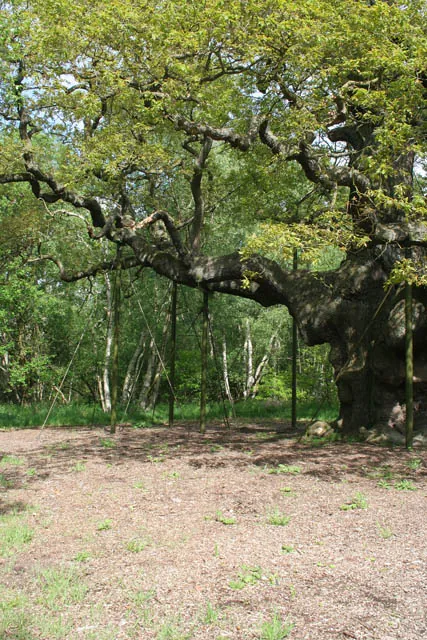
Illustrative photo, not an Augusta job.What Does Tree Cabling Cost in Augusta, GA?
Every tree prices differently, so be wary of anyone quoting a flat rate over the phone without seeing the tree.
What Determines the Price?
A single cable on a small ornamental tree and a multi-cable system on a 70-foot water oak are completely different jobs.
Get the tree evaluated before deciding what it needs.
The goal is an honest answer — including an honest recommendation when cabling is not the right call.
You receive a written estimate before work begins.
Call (706) 204-7547Built for Augusta’s Trees
Augusta grows trees that get big and live long — including water oaks, live oaks, and willow oaks with broad crowns that catch substantial wind.
Summer thunderstorms across the CSRA repeatedly test weak unions in mature canopies. Established neighborhoods can also have large shade trees growing close to homes, driveways, and other valuable targets.
Large crowns. Heavy limbs. Weak unions worth watching.
The tree’s species, growth pattern, structure, condition, and surroundings all influence whether support hardware is appropriate.
Tree Cabling & Bracing FAQs
Straight answers about support hardware, structural weaknesses, inspections, and when removal may still be the better option.
What is tree cabling and when does a tree need it?
Can cabling save a tree that is already splitting?
How long do tree support cables last?
Will drilling for cables and rods damage my tree?
Is cabling better than removing a leaning tree?
How often should a cabled tree be inspected?
Does cabling work on all tree species?
Tree Cabling & Bracing Around Augusta
Tree cabling and bracing is available in Augusta, Martinez, Evans, and surrounding CSRA communities.
Don’t wait for the next storm to reveal the weakness.
A visible split, competing trunks, or heavy limbs over a valuable target are reasons to have the tree evaluated before the next severe weather event.
Call (706) 204-7547Have a split, competing trunks, or heavy limbs over your home?
Get the tree evaluated before the next storm does it for you. A structural assessment can determine whether cabling, bracing, another mitigation option, or removal makes the most sense.
Get a Structural Assessment
Call to discuss a visible split, weak union, competing trunks, storm damage, or heavy limbs over a structure.
(706) 204-7547Tree Removal Augusta
2215 Tobacco Rd, Augusta, GA 30906, USA
The cabling and bracing information on this page is intended to explain structural support options. Whether a particular tree is suitable for cabling or bracing depends on its actual condition, the soundness of the wood, the root zone, the target below, and an on-site assessment. Support hardware does not make every hazardous tree safe and is not a substitute for removal when structural failure is already too advanced.