
Land Clearing Services in Augusta, GA
Tree Removal Augusta clears five common property types: residential lots, commercial properties, acreage and development tracts, selectively cleared land, and brush-filled overgrown parcels. Each property has different conditions, end uses, and clearing requirements.
Clearing depends on what the property needs to become.
A backyard homesite, commercial parcel, wooded acreage, and heavily overgrown lot should not automatically be cleared the same way.
Residential Lot Clearing
Removes trees, brush, stumps, and debris for a new home, addition, pool, driveway, outbuilding, or landscaping project. Heavily overgrown lots may contain mature pines, privet, vines, stumps, and accumulated debris.
New construction clearingCommercial Land Clearing
Opens building sites, access areas, and parking areas so construction can move onto clear ground. Larger development parcels require clearing limits, equipment routes, sequencing, and debris planning.
Plan the clearing scopeAcreage Clearing
Removes timber, brush, and dense vegetation from larger parcels for development or property improvement. Vegetation density, terrain, access, tree size, and the desired finished condition determine scope.
See cost variablesSelective Land Clearing
Removes unwanted vegetation while protecting desirable mature oaks, hickories, pines, views, shade trees, buffers, and other areas the property owner wants to retain.
See the processBrush & Underbrush Removal
Clears dense undergrowth, vines, and invasive plants such as kudzu, Chinese privet, and English ivy. Removing heavy brush can reclaim usable areas and improve visibility around property boundaries.
Compare methodsDevelopment Tracts
Larger parcels require a coordinated clearing plan that considers construction access, clearing boundaries, vegetation handling, stump requirements, debris management, and the eventual site condition.
Construction clearingLand Clearing for New Construction
Construction clearing removes vegetation, stumps, and debris from the building footprint and surrounding work area so excavation and grading can begin.
Stumps and roots under future foundations or pavement can decay and contribute to settling, which makes stump handling an important part of construction-related clearing.
- Mark clearing limits around the building pad, driveway, and utility routes.
- Remove trees, brush, vines, and other vegetation inside the limits.
- Handle stumps and roots beneath future foundations and pavement.
- Open equipment routes for machinery, concrete trucks, and deliveries.
- Manage debris so grading can begin on clear ground.
Forestry Mulching vs. Traditional Land Clearing
The right method depends on vegetation, terrain, access, stumps, soil protection, and the finished condition required.

Six factors determine the method
- Vegetation type and density
- Terrain and ground conditions
- Equipment access
- Desired finished condition
- Whether stumps must be removed
- Construction requirements
| Method | How It Works | Best For | Important Limit |
|---|---|---|---|
| Forestry Mulching | Mulching head grinds trees, brush, and vines into mulch left onsite. | Dense brush, small-to-mid trees, sloped or soft ground, soil protection. | Stump bases and roots generally remain unless separately ground or pulled. |
| Mechanical Clearing | Excavators and bulldozers push, pull, stack, and remove vegetation and stumps. | Building pads, foundations, full stump/root removal, grading. | Can create more soil disturbance and leaves debris to manage. |
| Selective Clearing | Crew removes marked vegetation while protecting selected trees. | Homesites, views, shade, buffers, and properties where desirable trees remain. | Slower production and requires accurate boundary marking. |
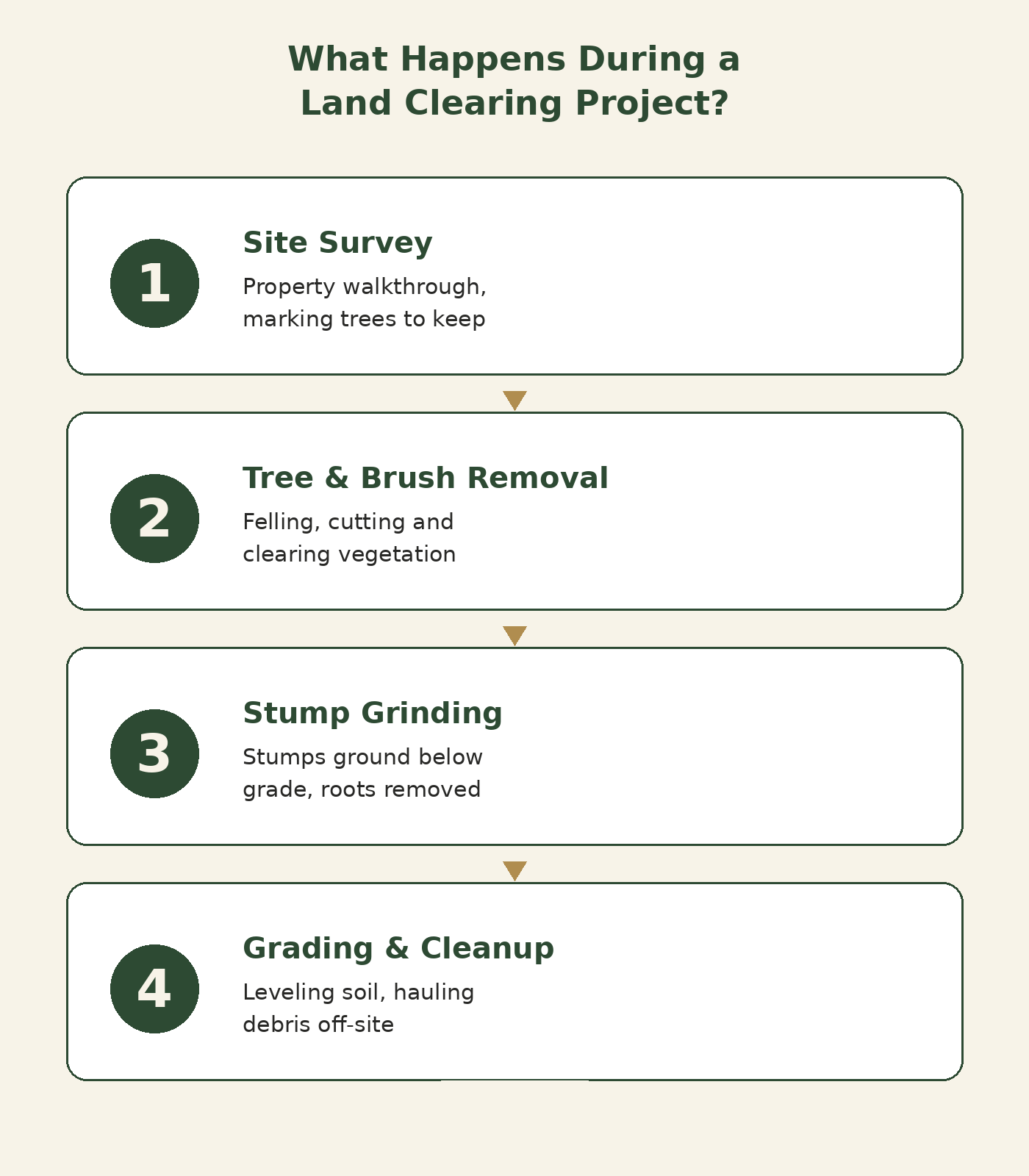
What Happens During a Land Clearing Project?
A clear process prevents uncertainty about what comes down, what stays, what happens to stumps, and what condition the property should be left in.
Site Assessment
Review vegetation, terrain, equipment access, hazards, and existing conditions.
Clearing Limits
Define boundaries, protected trees, no-clear zones, and the area included in the estimate.
Method & Equipment
Select the appropriate combination of mulching, excavation, pushing, chipping, or grinding.
Vegetation Removal
Remove trees, brush, vines, and other vegetation inside the agreed clearing limits.
Stump Handling
Grind or pull stumps based on the finished condition required for the property.
Debris Management
Mulch, chip, pile, haul, or dispose of material according to the written scope.
Final Cleanup
Leave the site in the agreed rough-cleared, raked, or otherwise specified final condition.
Land Clearing Equipment
Equipment should match the vegetation, terrain, access, and desired finished condition—not simply the acreage.
| Equipment | Primary Function |
|---|---|
| Forestry Mulcher | Grinds trees, brush, and vines into mulch onsite. |
| Excavator | Pulls stumps, removes root balls, and loads debris. |
| Bulldozer | Pushes cleared material into piles and can rough-grade areas. |
| Compact Track Loader | Carries brush, mulch, and soil across soft or uneven ground and can carry mulching attachments. |
| Chipper | Reduces limbs and brush to chips for onsite use or hauling. |
| Stump Grinder | Grinds stumps below ground level for lawns, driveways, landscaping, and similar finished areas. |
Stump Removal After Land Clearing
Vegetation can be removed without automatically removing every stump. The finished use of the property determines what happens next.
Stump Grinding
Grinds the stump below ground level for lawns, driveways, landscaped areas, and other locations where the visible stump needs to be removed.
Stump Pulling
An excavator removes the stump and root ball when building pads, foundations, or other construction requirements call for more complete removal. The hole then needs appropriate filling and compaction.
Stump Retention
Some wooded trails, pasture edges, and wildlife areas can retain selected stumps so they decay naturally over time.
Debris Removal & Disposal
Land clearing can end with onsite mulching, chipping, hauling, disposal where applicable, or a combination of these outcomes. The estimate should identify what happens to the material.
- What stays onsite: mulch, chips, or logs?
- What gets hauled away: limbs, root balls, or brush piles?
- Where is material being disposed of?
- Are disposal fees included?
- What final cleanup condition is included?
- Who handles debris generated by stump work?
The finish matters as much as the clearing.
“Cleared” can mean rough-cleared ground, a raked site, a mulch-covered area, or a site prepared for the next construction step. Put the expected final condition in writing before work begins.
Discuss Debris HandlingLand Clearing Cost in Augusta, GA
Acreage alone does not determine land clearing cost. Two five-acre properties can require very different equipment, labor, production time, stump handling, and debris management.
A site assessment turns those variables into a written number rather than relying on a generic online estimate.
Request a Written Estimate
Nine variables that affect the price
What Does a Land Clearing Estimate Include?
Compare estimates item-by-item so you know whether two contractors are actually quoting the same scope.
Clearing Scope
Boundaries, acreage, protected trees, and areas included in the work.
Trees & Brush
What comes down, what stays, and what vegetation is included.
Stump Handling
Grinding, pulling, retaining, or separate stump work.
Debris Handling
Mulching, chipping, piling, hauling, and disposal responsibilities.
Final Cleanup
Rough-cleared, raked, mulched, graded, or otherwise specified finish.
Equipment
Equipment requirements based on vegetation, terrain, access, and scope.
Site Conditions
Access, terrain, wet areas, obstacles, and other conditions affecting production.
Permits
Identify who is responsible for permit-related work when applicable.
Hauling & Disposal
State whether material leaves the property and where applicable disposal occurs.
Permits, Erosion & Site Protection
Clearing can affect more than vegetation. Project location, disturbance, drainage, wetlands, streams, and construction plans can change what needs to be reviewed before work begins.
Land Disturbance Permits
Permit requirements can depend on project size, location, and activity. Augusta guidance addresses excavation, filling, and grading, with certain exemptions. Verify current requirements with Augusta Planning & Development.
Erosion & Soil Protection
Vegetation removal exposes soil to rain and wind. Measures can include silt fences, temporary seeding, mulch cover, and stabilized construction exits where appropriate.
Wetlands & Floodplains
Wetlands, streams, and floodplains can limit clearing or trigger additional review. Check applicable maps and site features before finalizing clearing boundaries.
Signs Your Property Needs Land Clearing
| Property Condition | Potential Service |
|---|---|
| Overgrown lot with trees, brush, and vines | Forestry Mulching |
| Dense vegetation hiding structures, boundaries, or hazards | Brush Removal |
| Blocked construction area | Land Clearing for New Construction |
| Unused space on a large lot or parcel | Acreage Clearing |
| Difficult access to a driveway, gate, or trail | Selective Land Clearing |
| Kudzu, privet, or English ivy infestation | Brush Removal |
| Stumps left from earlier clearing or tree removal | Stump Grinding |
| Excessive brush after storms or previous clearing | Debris Removal & Disposal |
Land Clearing Services Across Augusta & the CSRA
Tree Removal Augusta handles land clearing projects in Augusta, Richmond County, and nearby CSRA communities.
Richmond County
Augusta and Hephzibah
Columbia County
Evans, Martinez, and Grovetown
Have the property details ready.
- Property address
- Approximate acreage
- Intended property use
- Vegetation type and density
- Equipment access
- Desired clearing level
- Stump and debris requirements
How to Choose a Land Clearing Contractor in Augusta
The lowest number is not necessarily the same scope. Compare the important details before choosing a contractor.
Scope
Confirm acreage, clearing limits, vegetation, and protected areas.
Insurance
Request proof of applicable insurance and verify details when needed.
Equipment
Make sure equipment matches terrain, access, vegetation, and scope.
Stumps
Ask whether stumps are ground, pulled, retained, or excluded.
Debris
Confirm what stays onsite, what is hauled, and who handles disposal.
Estimate
Look for a detailed written scope rather than a vague acreage price.
Permits
Assign responsibility for permits and site-related requirements.
Final Condition
Define whether the site will be rough-cleared, raked, mulched, or graded.
Questions Augusta Property Owners Ask
Straight answers to common questions about land clearing, forestry mulching, stumps, permits, and pricing.
How much does land clearing cost in Augusta, GA?
How long does land clearing take?
What does land clearing include?
Do land clearing projects require a permit?
Can land clearing remove stumps?
What is forestry mulching?
Ready to clear your Augusta, GA property?
Share the property location, approximate acreage, intended use, vegetation type and density, site access, desired clearing level, and stump or debris requirements. Those details help match the property condition to the appropriate clearing method.